
“Will AI replace engineers” is the wrong question because it assumes engineering is one thing. It is two things, and AI is wildly good at one of them and structurally blind to the other.
The first is local work: write this function, fix this bug, generate this test, refactor this file. The second is global work: decide what this system should be, where its constraints are, how it fails, and what the blast radius of a change is. AI eats the first. It cannot do the second, because the second requires holding a model of a system that does not fit in the context it operates on.
The engineers who get replaced are the ones who only do the first. The engineers who get more valuable are the ones who do the second.
What an LLM actually operates on
A language model predicts tokens conditioned on a context window. That is the whole mechanism, and the whole limitation. It is extraordinary at patterns that are visible within its context and patterns it absorbed during training. It has no resident model of your system.
Your system is not in its context. Your production topology, the undocumented reason service A retries against service B, the latency budget that a queue silently depends on, the migration that half-finished two years ago and left a load-bearing hack, the regulatory constraint that makes the obvious design illegal: none of that is in the window. Some of it is not written down anywhere. It lives in the heads of the people who built it.
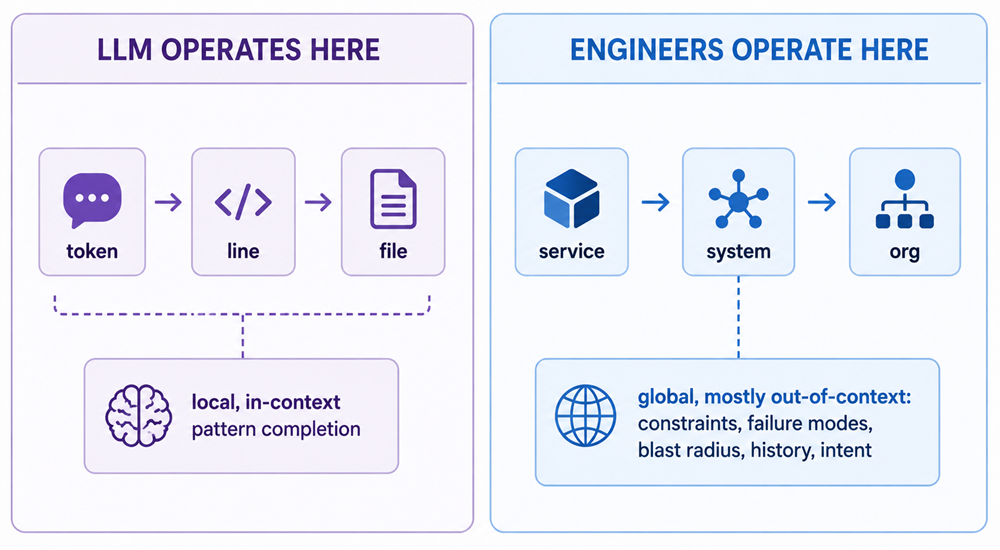
This is not a temporary limitation that a bigger context window fixes. You can stuff more tokens in, but the system’s truth is partly unwritten and partly emergent, and emergent properties are not retrievable. The model can describe how a circuit breaker works. It cannot tell you that turning this one on will overload a downstream dependency that has no breaker of its own, because that fact exists only in the interaction of components it has never seen running together.
The scarce skill is the system model
The valuable engineer is not the one who types fastest or even reasons best about an isolated algorithm. It is the one who carries an accurate model of how the whole thing behaves and fails.
That model is what lets you answer the questions that actually matter:
- If this changes, what else moves?
- Where does load concentrate under failure, not under normal traffic?
- What is the worst thing that happens if this assumption is wrong?
- Is this the real problem or a symptom of a problem one layer down?
- What can we not do here, because of a constraint that is not visible in the code?
AI does not answer these, because the information needed to answer them is not in its context and often not in anyone’s text. It is a property of the running system and the organization around it.
This is why senior engineers are not just fast juniors. The difference is not speed. It is the resident system model. AI replicates the speed and replicates none of the model.
AI changes the value of local work, not its existence
Here is the part that gets misread. AI does not eliminate local work. It compresses it. The time to produce a correct function drops toward zero. That is genuinely transformative, and it does have a casualty: the engineer whose entire value was producing correct local work at human speed.
If your job is to take a precise spec and turn it into a function, AI does that now, faster and cheaper, and you are competing with it on its strongest ground. That is the replacement story, and it is real. It is just narrower than the headlines.
But compressing local work increases the value of global work, for a simple reason. When the cost of implementation drops, the bottleneck moves entirely to deciding what to implement and understanding what implementing it will do. Cheap implementation makes expensive decisions more frequent. You can now generate ten plausible designs in an afternoon. Choosing the one that will not collapse under production load, that respects the constraints nobody wrote down, that fails safely, is harder and more leveraged than ever.
Cheap code raises the premium on judgment about code.
The trap: confusing fluency for understanding
The strongest counterargument is that models keep getting better at reasoning, and at some point the system model becomes learnable too. Worth taking seriously, and partly true. Models will absorb more of what is written down, and we will write down more, and agents will explore running systems and build richer context. The boundary moves.
But there is a structural reason it does not move all the way. A system’s most important properties are emergent and contested. They depend on live state, on organizational intent, on trade-offs that are decisions rather than facts. “Should we accept this risk to ship faster” is not a thing a model knows; it is a thing an organization decides, and the engineer who understands the system is the one who can frame that decision honestly.
There is also a failure mode that gets worse, not better, as models improve: fluent wrongness. A model that writes confident, well-structured, plausible code that is subtly wrong about your system is more dangerous than one that obviously flails, because it disarms the reviewer. The defense against fluent wrongness is an engineer with a resident system model who can say “this looks right and is wrong, here is why.” That defense becomes more necessary as the output becomes more fluent.
What to actually do with this
If you are an engineer, the strategic move is to stop competing with AI on local work and start compounding the thing it cannot do. Go deeper on the system. Understand the failure modes, the constraints, the history, the blast radius. Be the person who can look at a generated design and know what it will do in production. Let AI handle the typing.
If you lead engineers, the move is to stop measuring people by output volume, which AI now inflates indiscriminately, and start measuring them by the quality of their system reasoning. The engineer who prevents one catastrophic design decision is worth more than one who ships a hundred correct functions, and that ratio is getting more extreme.
If you are hiring, the signal shifts. “Can you implement this” is a weak filter now. “Can you tell me how this system fails, and what you would not do, and why” is the filter that separates the engineers who get more valuable from the ones who are being commoditized in real time.
AI did not make engineers obsolete. It made the line between local and global work the most important line in the field, and it put a lot of careers on the wrong side of it.
Key takeaways
- Engineering is local work (in-context, AI-strong) and global work (system model, AI-blind). The line between them is now the most important line in the field.
- A system’s load-bearing truths are partly unwritten and partly emergent, so they are not retrievable by a larger context window.
- Cheap implementation makes expensive decisions more frequent, raising the premium on judgment.
- Fluent wrongness gets more dangerous as models improve; the defense is an engineer with a resident system model.
- Engineers get replaced for only doing local work and get more valuable for owning the global model.