The quality engineering function is being absorbed. Not by automation, and not by AI. By engineering productivity.
This is uncomfortable for a lot of QE leaders, because they spent a decade arguing that automation would secure their seat at the table. It did the opposite. The more automation matured, the more it became obvious that the actual lever was never the test. It was the system that produces, ships, and observes code.
That system is now owned by platform and engineering productivity teams. Quality is becoming a property of that system rather than a separate discipline that inspects it.
Quality was always a property, never a department
Hold the org chart aside and ask a narrower question: where does quality actually get decided?
It gets decided in the half-second a developer waits for a unit test to run locally. It gets decided in whether the CI pipeline gives a clear failure or a flaky one. It gets decided in how fast a bad deploy can be rolled back, how good the observability is, how cheap it is to reproduce a production incident in a sandbox.
None of those are testing activities. All of them determine outcomes more than any test suite does.
The old QE model treated quality as something you add at the end through inspection. The newer model treats it as something you design into the delivery system so that defects are either impossible or cheap. That second framing is engineering productivity. It just happens to produce quality as a side effect.
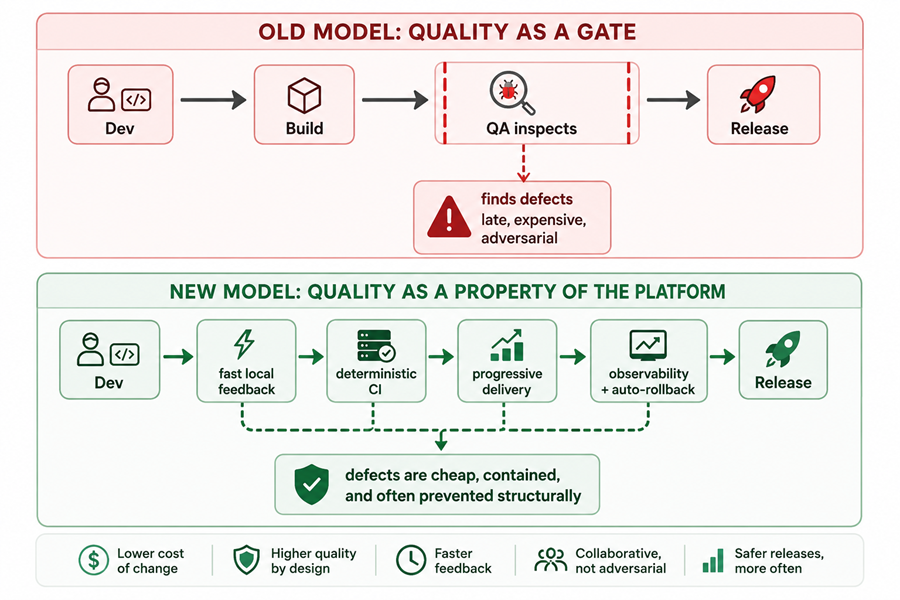
The first diagram is a checkpoint. The second is a control system. You cannot inspect your way to the second one.
The leverage moved, and most QE orgs didn’t
Here is the part that stings. Most QE organizations optimized the wrong layer.
They invested in more test coverage, more frameworks, more dashboards, more headcount writing more checks. That work has diminishing returns. The hundredth UI test does not meaningfully change your defect escape rate. It mostly adds maintenance.
The teams that moved the needle invested in feedback latency and delivery safety. Faster pipelines. Better test selection so engineers only run what matters. Hermetic builds. Preview environments per pull request. Trace-based debugging. Flake quarantine as an automated process rather than a Jira backlog.
Those investments compound. A pipeline that drops from 40 minutes to 6 minutes changes how an entire org behaves. Engineers merge smaller changes. Smaller changes mean smaller blast radius. Smaller blast radius means fewer severe incidents. Quality improved, and nobody wrote a test to do it.
This is the uncomfortable truth: a strong platform team with no dedicated QE function often ships higher quality than a weak platform team with a large QE function.
What this does to the QE role
The skill that retains value is not test authorship. It is system reasoning about failure.
A quality engineer who understands how a distributed system fails, where the risk concentrates, what the actual cost of a defect is in a given path, and how to instrument feedback for it, is enormously valuable. That person belongs on the platform team. They design the feedback system rather than operating it.
A quality engineer whose primary output is more Selenium or Playwright tests is going to find their role flattened into the platform, because the platform is where that work now lives anyway. Test execution is infrastructure. Test infrastructure is platform engineering.
So the career fork is real:
- One path leads to platform and engineering productivity, where you design the delivery system that makes quality cheap.
- The other path leads to commoditization, where test writing becomes a task that frontier coding agents do faster than you.
Most QE job descriptions are still written for the second path. Most QE value is now on the first.
The trade-off nobody wants to name
There is a real cost to folding quality into engineering productivity, and the people pushing this transition rarely admit it.
You lose the independent quality voice.
The classic QE function had a structural advantage: it did not report to the people whose code it was assessing. That independence created friction, and friction is annoying, but friction is also where uncomfortable truths surface. The tester who refuses to sign off on a release nobody else wants to block is doing something an embedded productivity engineer will not do, because the embedded engineer shares the delivery team’s incentives.
When quality becomes a property of the platform, the platform team optimizes for throughput. Throughput and risk tolerance are in tension. A platform team under pressure to increase deploy frequency will quietly raise the acceptable risk floor, and there is no longer an independent function whose job is to object.
The mature answer is not to keep a separate QE department as a veto. That model is slow and adversarial. The answer is to encode the independent quality position into the platform itself: risk-based deployment gates, error budgets that actually halt feature work when burned, blocking eval suites that the delivery team cannot bypass without explicit sign-off. The independent voice survives only if it becomes policy-as-code rather than a person in a meeting.
If you remove the QE department and do not encode its function, you do not get quality as a property of the platform. You get quality as an afterthought with better tooling.
What good looks like at scale
At organizational scale, the signal that you have made this transition correctly is mundane and measurable:
- Median pipeline time is short and trending down, not up.
- Test selection runs the relevant subset, not the full suite, on every change.
- Flake rate is tracked as a first-class reliability metric with an owner, not a nuisance.
- Change failure rate and mean time to recovery are owned by platform, reported alongside deploy frequency.
- Rollback is faster than fixing forward, and engineers trust it.
- Escaped defects are analyzed for systemic cause, not individual blame, and the fix is usually a platform change.
Notice that “test coverage” is not on that list. Coverage is an input metric that correlates poorly with the outputs that matter. The transition from quality engineering to engineering productivity is largely the transition from measuring inputs to measuring delivery outcomes.
The honest summary
Quality engineering is not dying. The label is migrating. The work that mattered, system reasoning about failure and feedback, is moving into platform and engineering productivity, where it has more leverage and a better view of the whole system. The work that did not matter as much, writing and maintaining a sprawling test estate, is being commoditized and will be commoditized harder by agents.
If you lead a QE org, the strategic move is to stop defending the testing department and start owning the delivery system. If you are an individual quality engineer, the move is to learn the platform deeply enough that you design the feedback loop instead of feeding it.
The seat at the table was never the test suite. It was always the system.
Key takeaways
- Quality is a property of the delivery system, not the output of an inspection step.
- Feedback latency and delivery safety compound; incremental test coverage does not.
- The durable QE skill is reasoning about system failure, which lives on the platform team.
- Folding quality into engineering productivity costs you the independent quality voice unless you encode it as policy-as-code and enforced gates.
- Measure delivery outcomes (change failure rate, flake rate), not coverage.